

Should You Throw Away Your Polyester? (Probably Not.)
A case for buying less, buying smarter, and dressing with intention

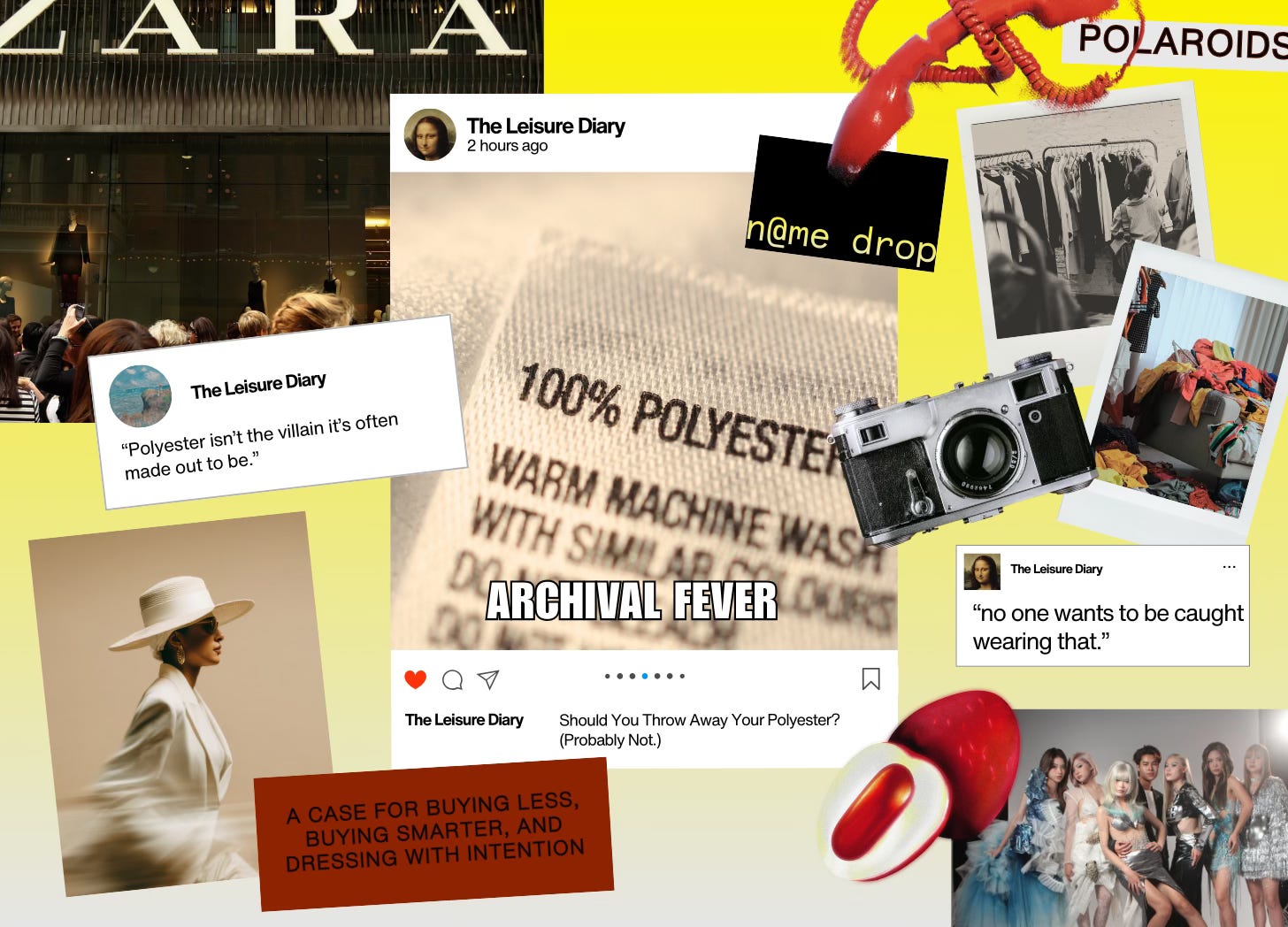
From luxury brands to off-price retailers like TJ Maxx and Marshalls, you’ve probably noticed the semi-bolded word polyester stitched into the seam. While many shoppers rarely stop to pay attention to the make of their garments — they should. Not just because synthetic production contributes to ocean waste and climate change, but also for a more selfish reason: polyester garments tend to visibly wear down. Over time, these garments will reveal their age through stretched collars, faded color, and mysterious holes. And no one wants to be caught wearing that.
Still, polyester isn’t the villain it’s often made out to be. Many designers gravitate toward the fabric because of its durability, wrinkle resistance, and accessibility. The real question is it more durable or just more cost effective and easier to mass produce.
So the question is “Should you throw away your polyester?”, the short answer is “no”.
I’m sure we all heard the phrase “reduce, reuse, recycle”, but when it comes to clothing, the application requires more nuance. Discarding garments the moment we learn about their environmental impact often creates more waste, not less. Whether you’re rebuilding a capsule wardrobe, committing to natural fibers, or entering a Marie Kondo inspired reset, slowing down before purging your closet may serve you better in the long run — it may be more cost effective to intentionally throw out a shirt here and dress there.
This is where the difference between buying less, buying better, and buying intentionally becomes critical.
Buying less means resisting impulse purchases and trend driven hauls. It’s about acknowledging that sustainability doesn’t begin with materials, it begins with restraint. Buying better, on the other hand, requires closer attention to construction, fiber blends, and longevity. Polyester isn’t inherently bad, but low-quality polyester designed for rapid turnover often is. A well-made garment, even one containing synthetic fibers, can outlast a poorly constructed “all-natural” alternative.
Buying intentionally takes the longest view. It asks you to consider not just how a garment looks or feels now, but where it will end up later. In the United States, only an estimated 15 percent of donated clothing is resold or recycled domestically. The rest is exported, downcycled, or ultimately discarded. To complicate matters further, roughly 50 to 60 percent of donated clothing is made from synthetic fibers like polyester, nylon, and acrylic. While donating may feel like a responsible choice, not all garments are reused equally and many never receive a second life at all.
This doesn’t mean you shouldn’t donate. It means you should donate with intention. Instead of defaulting to large resale chains, consider shelters, mutual aid organizations, or community groups that directly serve people in need. And before you part with a garment, ask yourself whether it still has value not just aesthetically, but functionally and responsibly.
Polyester doesn’t need to be banished from your closet. Thoughtless consumption does.
P.S. This is a practice I’m actively applying to my own wardrobe — editing slowly, keeping what lasts, and being more intentional about what I bring in next.